Romance, Regenerative Agriculture, and Rumi.
“Let go. Hold on. May you always.” So says the protagonist of Noy Holland’s Bird. She is a conflicted mother of two and wife of one, and the book follows her as she does her housekeeping, unable to make up her mind or keep it away from her previous lover, to which neither of her children belong. She doesn’t remember what she wants- is it better to let go or to hold on? But certainly one is the all defining answer, the cure, always. She describes a past which is desperate, hungry and romantic. In that past, she wanted to hold on with both hands. And won’t so many of us sacrifice what is happy for what is romantic, regardless of youth?
Take a cigarette. You might lean over the balcony on a rainy night and light an American Spirit in the midst of a romantic weather, and in the moments of smoking it you might feel more alive. You would not weigh it, then, against the actual living it may be taking from you. If the average cigarette takes ten to twenty minutes off your lifespan, you might take those as minutes where you would be doing your taxes, and this feeling of being alive would matter more for you. In the same way, you may chase someone who does not love you and deem it worth it for the small hit of dopamine when they look back nervously to see if you are still following them. (Or maybe this is a completely foreign feeling to you and you have no difficulty functioning in this world, in which case, well done.)
In short, you may be a romantic. And if you are a lover- of the beautiful, the thoughtful, anything- you also face the predicament of how to move on from it. All things are mortal- to love is also to learn how to grieve. In her poem Blackwater Woods, Mary Oliver writes:
To live in this world
you must be able
to do three things:
to love what is mortal;
to hold it
against your bones knowing
your own life depends on it;
and, when the time comes to let it go,
to let it go.
She says that to live in this world you must know how to let go- but it may still simply be impossible. Even if letting go is the one mortal toil, if the purpose of the soul on this earth may be to learn it- it might just be too hard.
In Phoebe Waller Bridge’s marvelous series Fleabag, the main character reflects on her mothers death. “I don’t know what to do with it… with all the love I have for her. I don’t know where to… put it, now.” And perhaps it can’t just disappear. Perhaps you do, you have to put it somewhere.
First, you have to know that all that love does not go to waste. In Amelia Dimoldenberg’s interview with Ethan Hawke at the 2026 Oscars, when asked about themes of unrequited love in one of his recent films and what advice he may have for someone in a similar situation, he said “the one in love always wins.” So the romantic is lucky as well as sensitive.
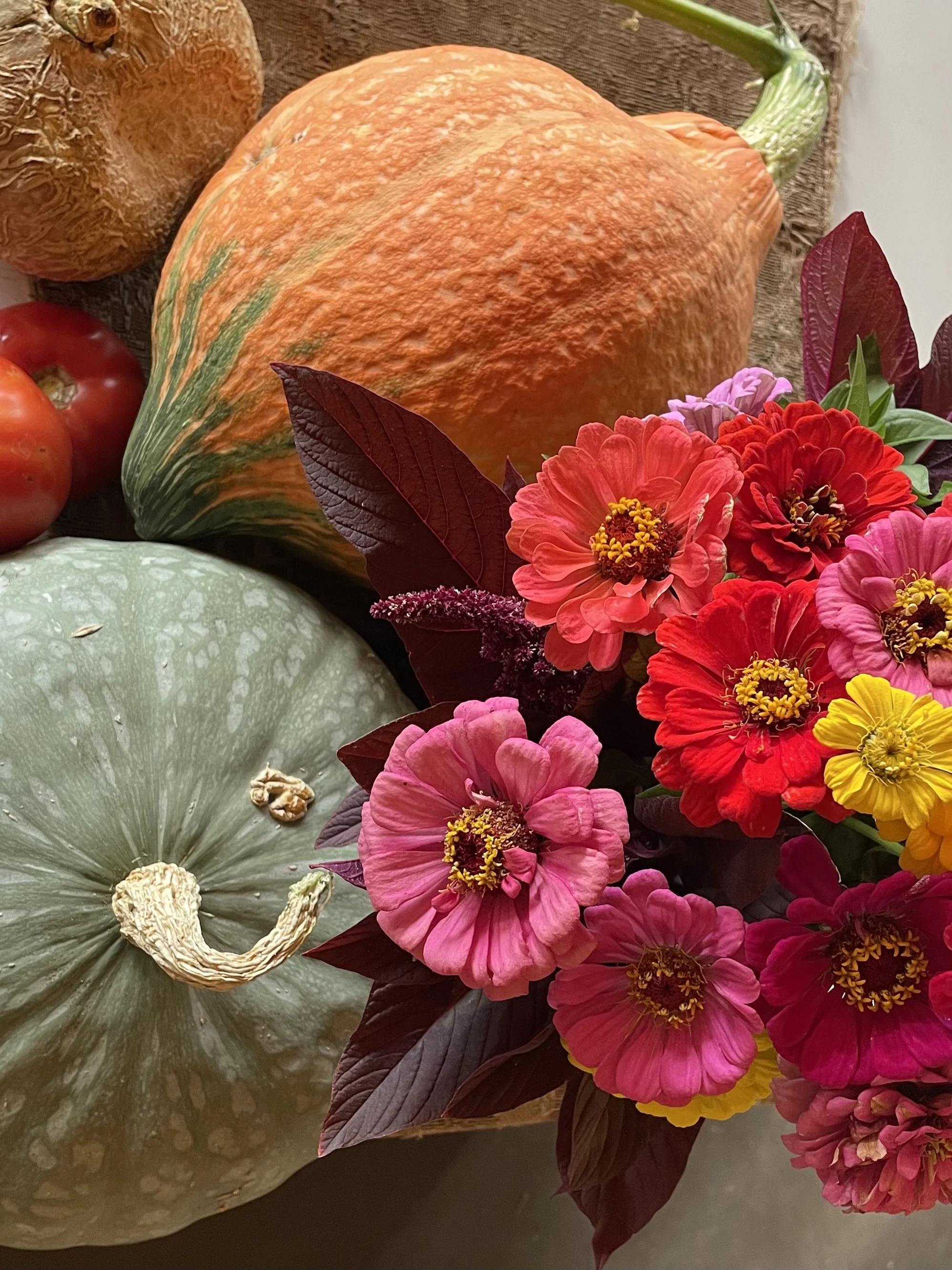
So in the end, where do you put that love? Somewhere which will keep it, will treat it well, will receive it. I have a proposal. I think we should put the love back into the soil. Put the love straight to the earth. We can find meaning here. We can channel our love and grow real, drinking and breathing flowers. We can use all that love to make this earth a beautiful place.
Regenerative agriculture is a practice where gardening focuses on growing the soil in order to grow what you plant in it, based on seven fundamental principles. (https://www.noble.org/regenerative-agriculture/soil/the-fundamental-principles-of-regenerative-agriculture-and-soil-health/) It is also a practice of love. The purpose of regenerative agriculture is to nourish the land so that it will nourish you, in much the same way that you hope to cultivate a relationship with another human being where you love and are loved in return. The practice works in mysterious ways, but the basis is consistent- when we put love into the earth, we get love back. In fact, in places where regenerative agriculture is practiced, rainfall actually increases (https://greencover.com/blogs/articles/regenerative-rainmaking) after only a couple years.
And, it turns out this cycle of uprooting what we do not know what to do with, much like grief over love, is not a new pattern for us as a society. In Gaia’s Garden, a permaculture guide, Toby Hemenway talks about the nature of weeds and how we misunderstand them. He gives purple loosestrife as an example. Purple loosestrife is known as an aggressive and invasive plant, and is recommended to be removed from the environments which it takes over. However, research shows that it cleans the water in the swampy environments it grows in, and can even withstand and filter many heavy metals. (https://www.sciencedirect.com/science/article/abs/pii/S0269749102001446) In the same way, we practice self sabotage by removing the dandelions from our yards so as not to disturb a lawn, when dandelions actively restore the minerals that grass depletes from the soil. Not to mention that the pesticides used to kill them are linked to cancer (you may not even need that cigarette- Pesticides and Cancer (https://www.frontiersin.org/news/2024/07/25/pesticides-smoking-risk-cancer)), even as the dandelions being removed are simultaneously being studied as the cure. (https://pmc.ncbi.nlm.nih.gov/articles/PMC12694484/)
A parallel may be drawn to how Sufi mystic Rumi presents emotions in his poem ‘The Guesthouse,’ where he says-
This being human is a guest house.
Every morning a new arrival.
A joy, a depression, a meanness,
some momentary awareness comes
as an unexpected visitor.
Welcome and entertain them all!
Even if they are a crowd of sorrows,
who violently sweep your house
empty of its furniture,
still, treat each guest honorably.
He may be clearing you out
for some new delight.
Rumi presents emotion as something to learn from, rather than to be gotten through. In his narrative, each has a meaning or purpose, some teaching which we can glean if we entertain it. If the anger is simply passed over or thrown out again and again, one may never know to heal the hurt which caused it. If the dandelion is pulled again and again, the soil may never be healthy.
It has been said a hundred times that love will not fix all of our problems. Unless there has just never been enough love before. In Anna Karenina, the book Leo Tolstoy described as the first real novel he had made, he writes “Respect was invented to cover the empty place where love should be.” One thing, one vital piece of each of our lives perhaps lacks both: the earth. It doesn’t have to be a loud revolution. One stubborn aloe vera in your window might actually do something for your depression. (https://pmc.ncbi.nlm.nih.gov/articles/PMC4419447/) One garden box can be something to put your heart into.
So- let go, hold on. Or plant potatoes.