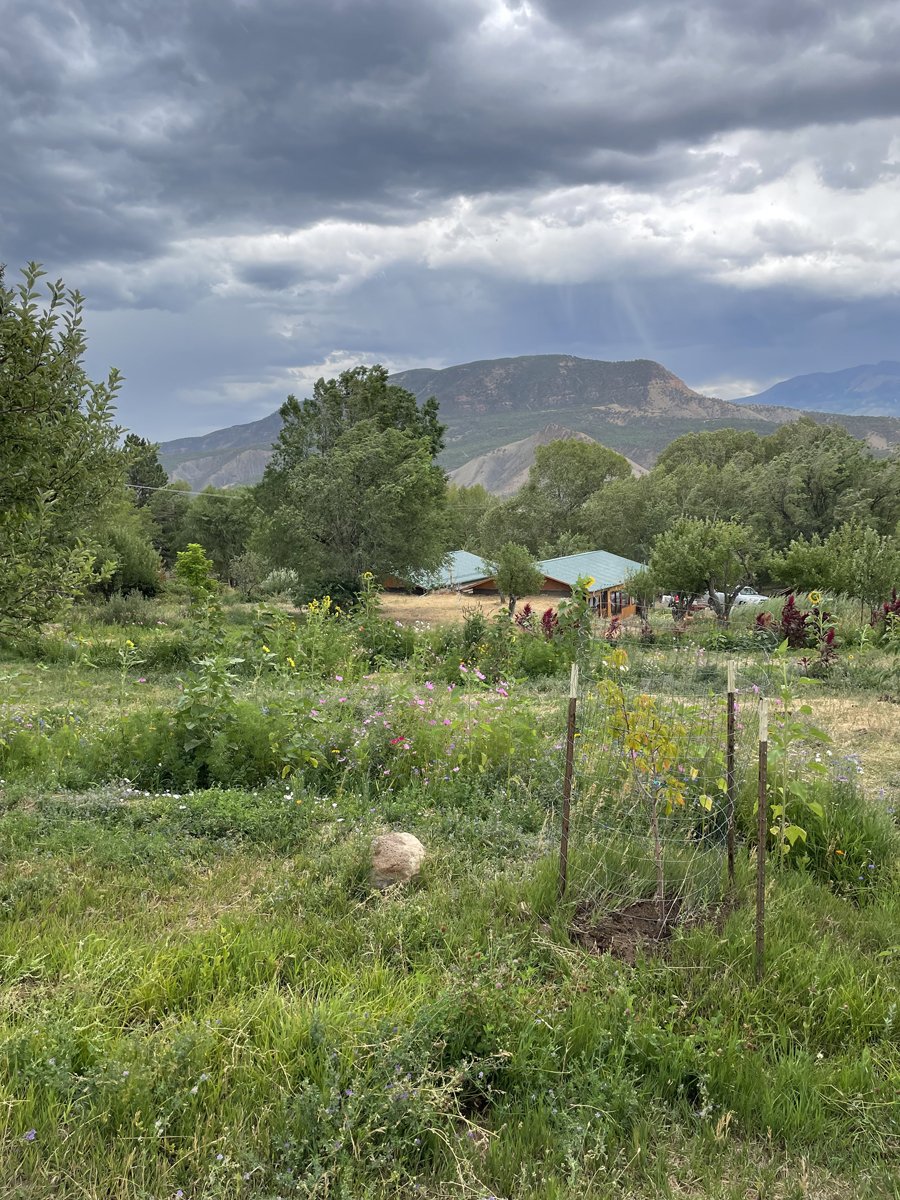
Terror Irrigation Ditch ended its season today.
I’m feeling incredibly grateful—for the provision of water we were given, and for what we were able to do with it to benefit the living beings on our three-acre parcel.
After installing swales and berms, planting pollinator-friendly wildflower seeds, putting in 100 asparagus plants and a few other perennial food crops, and covering the bare soil with organic hay that had already begun to decompose, I was committed to the system I had created. It became my responsibility to see that it received enough water to grow and thrive.
That often meant dragging myself outside in the wee hours, the reflected eyes of unknown species watching from the darkness as I moved water from swale to swale.
Throughout, the growing season averaged less than a two-inch pipe full of irrigation water, every three days. The farmer’s garden, the upper field of swales and berms, and the perennial plantings received priority. The remaining acre was left with less than an inch of rain for the entire summer, essentially left to fend for itself. Somehow the juniper and gnapweed survived.
This first year on our new property was primarily a year of observation.
One of the most fascinating things to watch was the behavior of the amaranth.
The same mixture of seeds was spread across each swale and berm, yet it quickly became apparent that different plants preferred different places. Some seeds seemed happiest on the berms. Others found the lower, wetter portions of the swales more to their liking. It didn’t take long until each swale and berm developed its own personality
I was especially interested in watching the amaranth choose its place.
Its brilliant red color made it impossible to miss. It called out for attention. Almost immediately, it established itself in Swale #3 at the bottom of the field. There, the many plants grew through the season, eventually reaching maturity and producing their own seeds.
Meanwhile, the 20-foot-wide alleyways between the swales and berms—areas that had been dominated by tiny mustard plants when we received the land—began their own stories. Over time we witnessed the effects of water being slowed, spread, sunk.
In one section, amaranth began appearing where the dry seeds had lain dormant. I called this the “second generation.” Then, as the soil continued to absorb and hold more water, another generation emerged.
The anticipated regeneration of the land had begun.
Be the Beaver
Our friend and farmer, Jake Takiff of Cedar Springs Farm, has been an incredible inspiration to us.
Jake’s farm was once 40 acres of dryland that received only tailwater from the landowners above him, no rightful irrigation. His property was covered with knapweed and sage, with only a dry streambed running through it. When water was released upstream, it would briefly move through the property then disappear.
Through a system of swales and berms, combined with working the six principles of soil health, Jake began holding the water instead of allowing it to evaporate.
Today, his farm is home to a perennial stream and numerous trout ponds. After almost a decade of this work, we can watch more water leaving his farm than what comes into it.
“Be the Beaver.” It is a simple yet profound idea: mimic the work that beavers once performed throughout our watersheds by slowing water down, spreading it across the landscape, and allowing it to sink into the soil.
Before beavers were trapped almost to extinction, they played a vital ecological role in shaping and supporting local hydrological systems. Their dams created wetlands, slowed runoff, recharged groundwater, and created habitat for countless other species.
Humans altered many of those systems. Now part of our responsibility is to help restore them.
A Different Kind of Irrigation
This season of irrigation has taught me that watering the land is about more than supplying plants with water.
It’s about learning to work with water.
It is about learning where water wants to go, where it gathers, what happens when we give it time to soak into the ground.
When I paid attention:
The amaranth taught me.
I learned from the swales.
Nighttime irrigation was a teacher too.
And Jake’s farm shows what can happen when these practices are sustained over time.
Jake’s once barren land is now a thriving ecosystem capable of supporting his family while also providing habitat for even endangered species that now choose his farm as their home. The transformation happened through the process of thousands of small decisions working with natural systems rather than against them.
This is reason to hope.
Our three acres are only three. But regeneration might start somewhere small.
A berm.
A swale.
A patch of bare soil covered with hay.
A person dragging a house to spread water into the darkness.
Eventually, a seed falling from a plant and finding itself in a place where it can grow.
Slow the water. Spread the water. Sink the water.
The past implores us not to forget.
The land will teach us what is next.